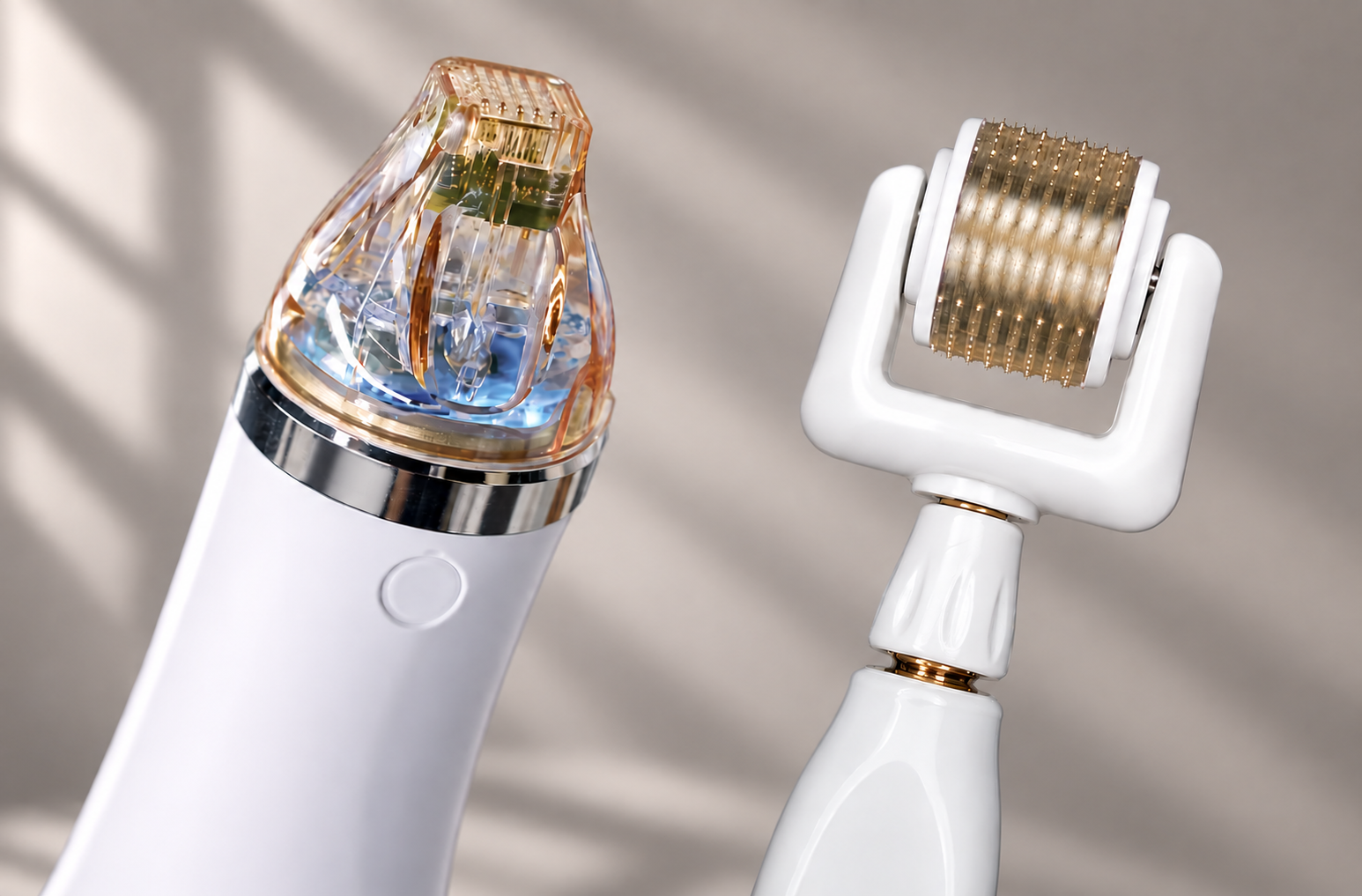
Two needle-based treatments, one meaningful difference. Here’s what plasma energy adds to traditional microneedling — and why that difference may matter for your skin.
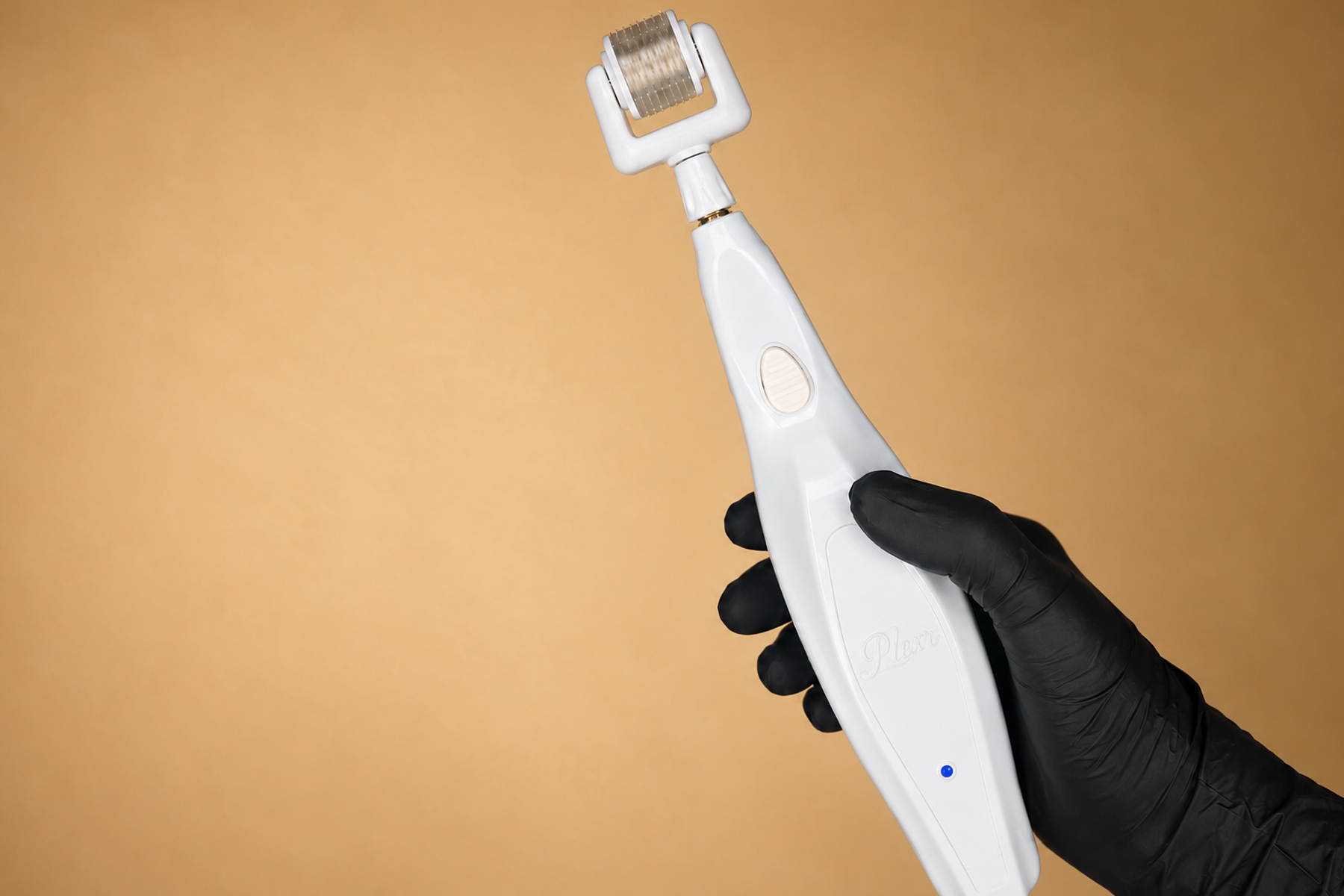
Quick Answer: Traditional microneedling stimulates collagen through mechanical injury alone. Plexr Lumen uses the same needle-based foundation but adds plasma energy during the same pass — combining mechanical stimulation with an added thermal effect.
If you’ve had microneedling before, you already know the basics: needles, some redness, collagen doing its thing over the following weeks.
What Traditional Microneedling Does for Skin
Traditional microneedling works through something called percutaneous collagen induction — basically controlled, mechanical injury created by fine needles. Dr. Des Fernandes formalized the modern derma-roller version of this back in 2005, and it’s held up well since.
Here’s the thing: the needles themselves don’t rebuild anything. They create a small, controlled injury, and your skin’s own healing process does the actual work — platelets and immune cells release growth factors, fibroblasts get to work, and collagen remodeling follows over the next several weeks. One large study of nearly 500 patients found real improvement in fine wrinkles, lax skin, scarring, and stretch marks using this mechanism alone — no energy, no added technology, just the needle and your skin’s own biology.
So that’s the whole mechanism: injury → healing response → collagen remodeling.
Why Mechanical Micro-Injury Stimulates Collagen
It’s easy to assume more needles, or deeper needles, is what makes this work. It’s not only about depth — it’s about the healing response the injury sets off. First there’s inflammation, then your skin lays down new collagen (type III, if you’re curious), and over the following months that collagen matures into the stronger type I collagen that actually holds skin together.
That’s why results build gradually, and why microneedling is usually done as a series rather than a single visit — each session restarts that process, and the collagen keeps building on itself.
CLINICAL INSIGHT —
Here’s what to know going in — the real change happens over the series, not the first visit. That first session sets things in motion. You may very well see some improvement early on, but the deeper collagen remodeling builds with each treatment. (The old line holds up: one session is a treat, a series is treatment.) Aftercare matters too — giving your skin the right conditions to do the work it’s built to do helps carry that process forward.
Video of Plexr Lumen Microneedling
What Changes When You Add an Energy Source
Traditional microneedling relies on that mechanical injury alone. Over the past decade or so, a whole category of “energy microneedling” has popped up that adds a second layer on top of that same foundation — most often radiofrequency (RF), which sends heat energy through the needles as they go in.
Plexr Lumen fits into this energy-microneedling category too, just with a different type of energy: plasma instead of radiofrequency.
We break down exactly how plasma energy differs from RF here: RF Microneedling vs. Plexr Lumen
What Plasma Energy Microneedling Is
Plexr Lumen combines the same mechanical micro-channeling used in traditional microneedling with plasma energy delivered through the needles during the same pass. This isn’t blood-derived plasma, as in PRP — it’s energy-based plasma generated by the device and delivered as part of the treatment.
Unlike Plexr Plus sublimation, where plasma is created across an air gap between the device tip and the skin, Plexr Lumen delivers plasma energy through its microneedling attachment during needling. The mechanical channels and plasma energy are therefore delivered together rather than through the surface sublimation technique used with Plexr Plus.
Independent peer-reviewed research on Plexr’s plasma exeresis technology has documented collagen remodeling in treated tissue using confocal microscopy. This research supports the broader biological effects of Plexr plasma technology, although it is not a direct study of the Plexr Lumen microneedling protocol itself.
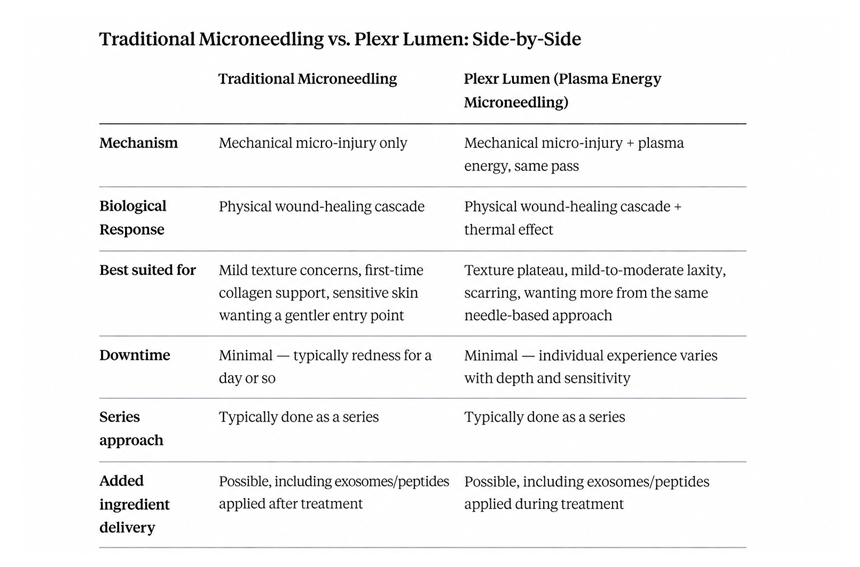
Traditional Microneedling vs. Plexr Lumen: Side-by-Side
Who Traditional Microneedling Still Suits Well
Plasma energy isn’t a universal upgrade. Traditional microneedling is still a great fit for plenty of people — especially if you want a gentler starting point, have reactive or sensitive skin, or your concerns are mild enough that the mechanical stimulus alone gets the job done.
The published research on the mechanical-only approach backs this up for mild-to-moderate concerns — fine wrinkles, early lax skin, scarring, and stretch marks. It’s also a solid starting point if:
- You’re new to microneedling and want to see how your skin responds before adding energy into the mix
- Your skin is sensitive or reactive and a gentler entry point makes sense
- Your main concern is texture rather than laxity
When Adding Plasma Energy May Make Sense (Who Plexr Lumen Suits Best)
Plexr Lumen may be a good fit if you’re dealing with:
- Texture that’s plateaued on mechanical-only microneedling
- Mild-to-moderate laxity alongside texture or scarring
- Wanting the same needle-based approach, plus some added tightening
- Fine lines, photoaging, or acne scarring and post-inflammatory texture — this gets personalized to your skin
As with any energy-based treatment, candidacy is confirmed at consultation rather than off a list — your skin, your goals, and your health history all factor into whether Lumen or traditional microneedling is the better place to start.
Texture, Laxity, Scars, and Overall Skin Quality
Traditional microneedling has a solid track record specifically for stimulating collagen regeneration — supporting real improvement in texture, acne scars, and other types of scarring. It’s one of the better-studied uses of the mechanical-only approach. When plasma energy gets added, the extra thermal component is what supports firmness and tightening on top of that same collagen/texture/scarring benefit. If laxity is part of what you’re dealing with, not just texture, the added energy component may be the better fit. If texture is your main concern and you’re happy with the mechanical approach alone, you may not want to add anything extra.
Why This Matters More During Perimenopause and Menopause
As estrogen declines, collagen production slows, and skin gradually loses some of the structural support that keeps it firm and resilient. Once laxity becomes part of the picture, it’s worth considering whether adding plasma energy makes sense for you.
Downtime and Treatment Series
Like traditional microneedling, Plexr Lumen is typically done as a series rather than a single session — collagen remodeling takes time, and each session builds on the last. Downtime for both is generally minimal, though it varies a bit person to person depending on depth, sensitivity, and skin condition.
CLINICAL INSIGHT —
In practice, we see similar downtime between the two — usually 24 to 48 hours of redness. That tracks with the published range for traditional microneedling too, generally 24 to 72 hours before things settle down.
Where Exosomes and PDRN Fit
Both traditional microneedling and Plexr Lumen create microchannels, and topical products may be incorporated into the treatment protocol. With Lumen, things like exosomes or PDRN can be added on as an option post-treatment.
These products aren’t what creates the treatment’s actual effect, though — that comes from the mechanical needling and, with Lumen, the added plasma energy. The biostimulants support the process; they don’t drive it.
CLINICAL INSIGHT —
In practice, a post-procedure product for regeneration and soothing is part of every treatment. Exosomes specifically are optional — it comes down to preference and budget, not necessity.
FAQS
Q&A: What is energy microneedling?
It’s a category that pairs mechanical needling with an added energy source — most often radiofrequency, or in Plexr Lumen’s case, plasma energy microneedling. Traditional microneedling relies on the needles alone; energy microneedling adds a second stimulus in the same pass.
Q&A: Is Plexr Lumen the same as PRP microneedling?
No. PRP microneedling uses platelet-rich plasma drawn from your own blood, applied after needling. Plexr Lumen uses energy-based plasma generated by the device itself, delivered through the needles during treatment — it has nothing to do with blood.
Q&A: Microneedling stopped working for me. What else is there?
If traditional microneedling has plateaued for you, Plexr Lumen is worth a look. It takes the same mechanical microneedling foundation and adds plasma energy as a second stimulus. So you’re not abandoning what already works for you — you’re adding another layer to it. A consultation can help you figure out if that makes sense for where your skin’s at.
Q&A: How do I know which microneedling option is right for me?
It depends on your skin, your goals, and what you’ve already tried — there isn’t one option that’s automatically right for everyone. A consultation is the best place to sort that out.
Sarah is a Registered Nurse and founder of Gia Sena, providing regenerative plasma energy aesthetics in Calgary. Her approach blends clinical expertise with a regenerative philosophy, supporting midlife skin through treatments that restore structure, resilience and long-term skin health.
Sources:
- Fernandes D. Minimally invasive percutaneous collagen induction. Oral Maxillofac Surg Clin North Am. 2005;17(1):51–63.
- Aust MC, Fernandes D, Kolokythas P, Kaplan HM, Vogt PM. Percutaneous collagen induction therapy: an alternative treatment for scars, wrinkles, and skin laxity. Plast Reconstr Surg. 2008;121(4):1421–1429.
- Rossi E, et al. Clinical and confocal microscopy study of plasma exeresis for nonsurgical blepharoplasty of the upper eyelid. Pilot study of plasma exeresis.
- NeoGen White Paper. March 2025. References include Kilmer et al. (2005), Potter et al. (2005), and Gonzalez et al. (2008).
- GMV Medical Innovation. Plexr Lumen Webinar Presentation. November 2025. Manufacturer information on Plexr Lumen microneedling and plasma-energy technology.
Book your Consultation
This is where we tailor it, for you.