Plasma energy isn’t PRP, downtime depends on what you want, and treatment time depends on the area. Here are the questions I hear most in the chair, with straight answers.

The same questions come up in almost every consultation I do. Some of them come from how new plasma energy still is in Calgary. Others come from the word “plasma” meaning two completely different things in aesthetics.
These are the plasma energy treatment questions I hear most about Plexr and NeoGen, from downtime and safety to which areas we can treat and when you’ll see results. Here’s what I tell people.
1. Is plasma energy the same as PRP?
No. They share a word and nothing else.
PRP (platelet-rich plasma) comes from your blood. A sample is drawn, spun in a centrifuge to concentrate the platelets, and the result is injected or applied to the skin, often during microneedling. In PRP, “plasma” refers to the liquid part of blood.
Plasma energy has nothing to do with blood. Plasma is the fourth state of matter, alongside solid, liquid and gas. It forms when energy is applied to a gas, and it’s the same phenomenon behind a lightning bolt, scaled down to a controlled, medical-grade level. Plexr and NeoGen both generate plasma energy and deliver it to the skin to stimulate collagen and elastin. There’s no blood draw involved in any of them.
Searching “plasma microneedling” or “plasma facial” often turns up PRP results, which explains a lot of the confusion.
I get this one a lot, and it usually comes out as “Wait, do you have to draw my blood?” Nope. With Plexr and NeoGen, the plasma comes from the device, not from you.
2. Is there downtime with plasma energy treatments?
It depends on what you want the treatment to do. Downtime and depth of change tend to travel together, so the question I ask back is what you’re hoping to change and how much time you can set aside for recovery.
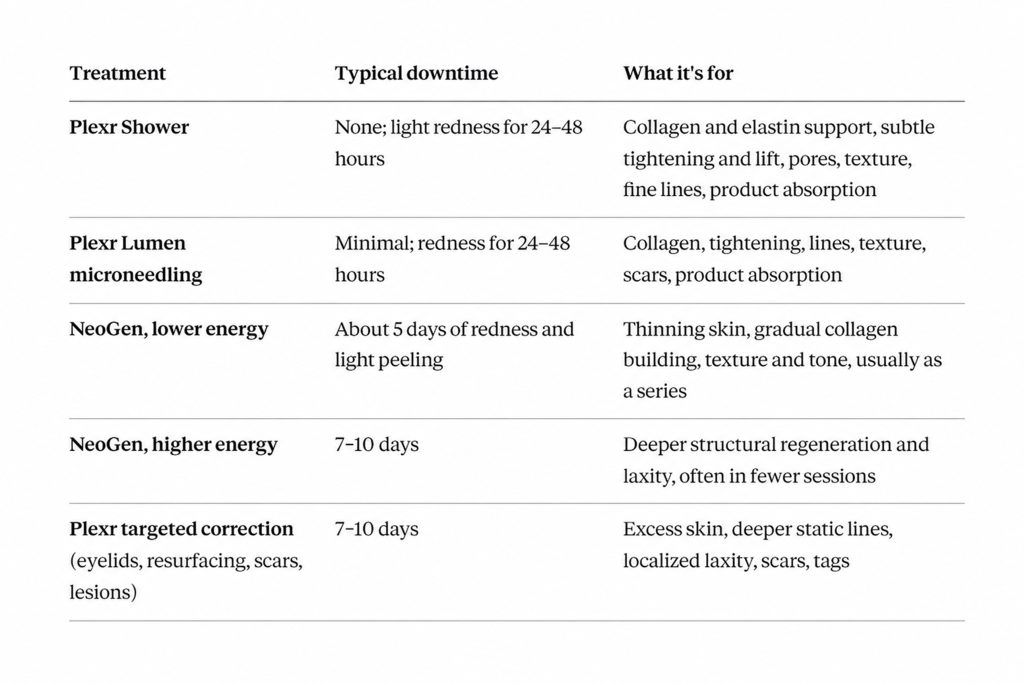
Table comparing downtime for Gia Sena plasma energy treatments.
Plexr Shower sits in its own category in my treatment menu because it gives me a no-downtime option when the goal is collagen support, subtle tightening and improved product absorption. The plasma creates thousands of nano channels in the skin’s surface, which improves how well products absorb afterward. That combination makes it a common starting point and a great maintenance treatment.
Plexr Lumen combines microneedling with Plexr plasma energy in the same pass. The needles create micro channels as the plasma is delivered, which also opens the skin to the regenerative product applied after treatment. Expect 24 to 48 hours of redness.
With Plexr targeted correction (semi-ablative), small carbon crusts form on the skin and act as a protective layer while it heals. Plan for 7 to 10 days downtime.
NeoGen scales with energy. At the very low end, many people have mild redness and go straight back to normal life, and it’s a good fit for thinning skin that needs strengthening over a series of sessions. As energy increases, so do redness, peeling and recovery time, and the regenerative response goes deeper.
The Recovery Guide Page shows real day-by-day healing photos for both Plexr (semi-ablative) and NeoGen.
3. How long does a plasma energy treatment take?
It mostly depends on the area.
- Plexr Shower: about 45 minutes
- Plexr Lumen microneedling: about the same, depending on what’s being treated
- Plexr targeted correction: anywhere from an hour to 3+ hours, depending on the area
- NeoGen: 45 minutes to an hour for lower energy without numbing, and up to 2 hours with numbing, higher energy or broader coverage
That last range is wide because Plexr isn’t limited to the face. An upper eyelid is a small, precise area. A neck, jawline or stomach covers far more surface. When prescription numbing is part of the plan, the time it needs to take effect is built into the appointment.
4. Can you treat areas besides the face?
Yes. Plexr and NeoGen can both be used on the body wherever there’s laxity. The areas people ask about most are the stomach, the skin just above the knees, the upper arms, the neck, the jawline and the hands. Plexr is also used for stretch marks and body scarring. Which device fits depends on the area and what the skin needs, and some plans use both.
One area I’ve been treating more is the skin just in front of the ears — the preauricular area — continuing down past the jawline into the neck. Treating that whole area together can create a subtle lifting and tightening effect through the side of the lower face.
Loose skin on the body often shows up after pregnancy, with the general loss of firmness that comes in midlife, and after significant weight loss. That last one is coming up more with GLP-1 medications like Ozempic. When weight comes off quickly, the skin doesn’t always tighten back at the same pace, and in midlife, collagen is already declining. The result can be looser skin on the stomach, arms and thighs, not just the face.
5. Does it hurt?
Most clients find it very manageable, and it varies by treatment.
- Plexr Shower and other non-ablative treatments are generally described as painless or tolerable.
- Plexr Lumen microneedling feels similar to traditional microneedling, and how much you feel depends on the depth used and your skin’s sensitivity.
- Plexr targeted correction feels like a mild pinprick or a quick heat sensation against the skin.
- NeoGen feels like a series of warm pulses, and you’ll hear a snapping sound from the device.
With either device, you may notice a brief smell similar to burning hair. That’s normal and it passes. Topical numbing is used when the treatment and area call for it.
The sound surprises people more than anything. NeoGen makes a snapping sound as each pulse fires, so I always warn people before we start. It sounds worse than it feels.
6. Is it safe? What if it goes wrong?
Plexr and NeoGen are medical-grade plasma devices licensed by Health Canada. When a trained provider performs them, both have a strong safety profile.
Safety also depends on who is being treated. Some conditions delay or rule out treatment, including uncontrolled diabetes, pregnancy or breastfeeding, active cancer, a history of keloid scarring, vitiligo, Accutane within the last six months, and recent tanning. That’s why the consultation includes a full health history review.
When people search “Plexr gone wrong,” some of what they’re seeing is normal healing: swelling, carbon crusting, redness and pinkness that wasn’t properly explained beforehand. Complications can happen, which is why appropriate client selection, the device being used, provider training and aftercare all matter.
I go through the full healing process before anyone books so they know exactly what their skin will look like each day.
For more on this, see Is Plexr Safe?.
7. Can plasma be used around the eyes?
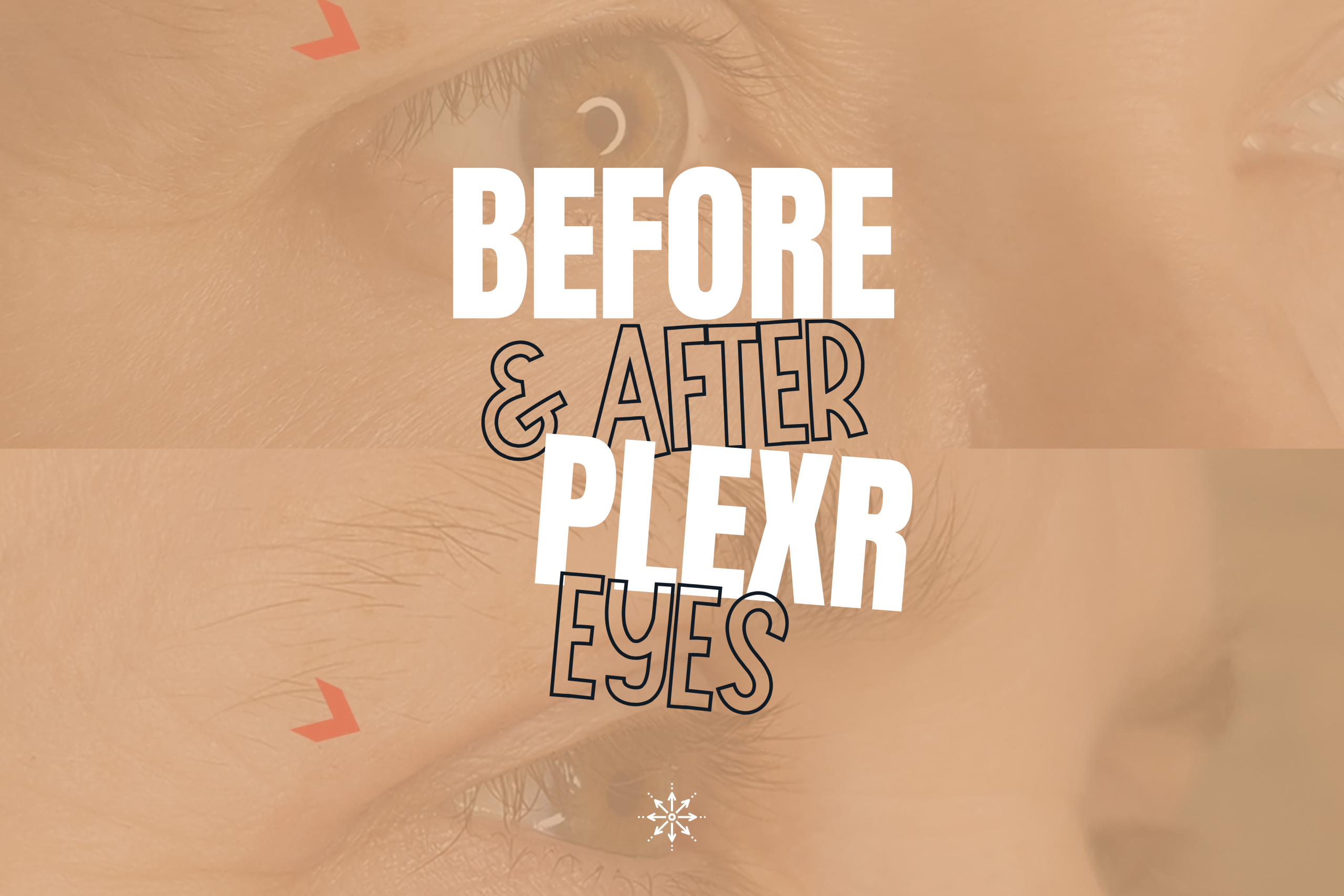
Yes. Plexr and NeoGen can both be used on the upper and lower eyelids without internal eye shields, which many laser treatments require.
They work differently there. Plexr targeted correction removes and tightens excess upper or lower eyelid skin, which makes it the usual choice for hooding. NeoGen strengthens and tightens the skin without removing tissue, which suits crepey or thinning skin around the eyes. A plan can use both in different areas. The Eye Lift page covers the options in full.
8. How many sessions will I need?
That depends on your skin, your goals and the treatment.
For Plexr Shower and Plexr Lumen, sessions are spaced every 4–6 weeks as a foundation series. As a general starting framework in my practice, I often think in terms of roughly three treatments in the 30s, four in the 40s and five in the 50s, but skin quality matters more than the number on your driver’s licence. The decline in collagen that speeds up through perimenopause and menopause means there’s more to rebuild, so more sessions may be needed to establish that foundation before moving to maintenance.
For upper eyelid laxity with Plexr, each treatment produces roughly a 30% reduction in visible laxity, so most clients plan for 1 to 3 sessions and 2 is the most common. Lower eyelids usually need a single treatment.
Lower-energy NeoGen is usually done in a series. Higher-energy NeoGen may be one or two treatments, followed by maintenance as needed.
9. When will I see results, and how long do they last?
With Plexr Shower and Plexr Lumen, results build gradually across the series as collagen and elastin rebuild, so the change is progressive rather than all at once.
With Plexr targeted correction (semi-ablative), you’ll see results once the swelling settles and the crusts fall away, and it keeps tightening as the tissue remodels over the following weeks.
NeoGen takes longer because it’s regenerative. Use 30, 60 and 90 days as a rough guide, with most people noticing the clearest shift closer to 90 days. Age plays a part. Skin in the 40s tends to show change a little earlier in that window, while skin in the 50s and beyond usually takes a bit longer but still begins within three months and keeps improving. Collagen formation can continue for up to 24 months.
Results typically last several years. Hydration, sleep, nutrition, sun protection and a consistent skincare routine all affect how well your skin holds on to them.
10. Is Plexr the same as a plasma pen?
“Plasma pen” is a general name used for many different devices, and they vary widely in how they’re built and how they’re regulated. Plexr is a medical device licensed by Health Canada, and at Gia Sena it’s used by a Registered Nurse with specific Plexr training.
If you’re comparing plasma treatments, ask two questions: which device is being used, and is it licensed for use in Canada.
If your question isn’t here, my FAQ page covers more, and I’m always happy to answer it directly. You can reach out through the contact form below.
Sarah is a Registered Nurse with more than 23 years of nursing experience and the founder of Gia Sena in Calgary, Alberta. Her practice focuses on regenerative aesthetics using NeoGen nitrogen plasma and Plexr plasma energy treatments, with a particular interest in the skin changes that occur through perimenopause, menopause and midlife.
Sources
- Alster, T.S., & Konda, S. (2007). Plasma skin resurfacing for regeneration of neck, chest, and hands: investigation of a novel device. Dermatologic Surgery, 33(11), 1315–1321. https://doi.org/10.1111/j.1524-4725.2007.33282.x
- Bentkover, S.H. (2012). Plasma skin resurfacing: personal experience and long-term results. Facial Plastic Surgery Clinics of North America, 20(2), 145–162. https://doi.org/10.1016/j.fsc.2012.02.010
- Bogle, M.A., Arndt, K.A., & Dover, J.S. (2007). Evaluation of plasma skin regeneration technology in low-energy full-facial rejuvenation. Archives of Dermatology, 143(2), 168–174. https://pubmed.ncbi.nlm.nih.gov/17309997/
- DermNet NZ. Platelet-rich plasma: dermatological applications. https://dermnetnz.org/topics/platelet-rich-plasma-dermatological-applications
- Health Canada. Medical Devices Active Licence Listing (MDALL). https://health-products.canada.ca/mdall-limh/
Book your Consultation
This is where we tailor it, for you.