
There’s something pretty satisfying about seeing this much change just nine days after a Plexr eyelid treatment. She’s in her late 50s, and these are her upper and lower eyelids after one treatment here at our Calgary clinic.
Quick answer: At Day 9 after one Plexr treatment, this client showed an estimated 5 mm of upper eyelid lift, and her under-eye laxity was no longer visible. A few carbon crusts were still healing, and tightening continues for weeks after, so this is an early result, not a final one. You can see more eye treatment images in the results gallery.
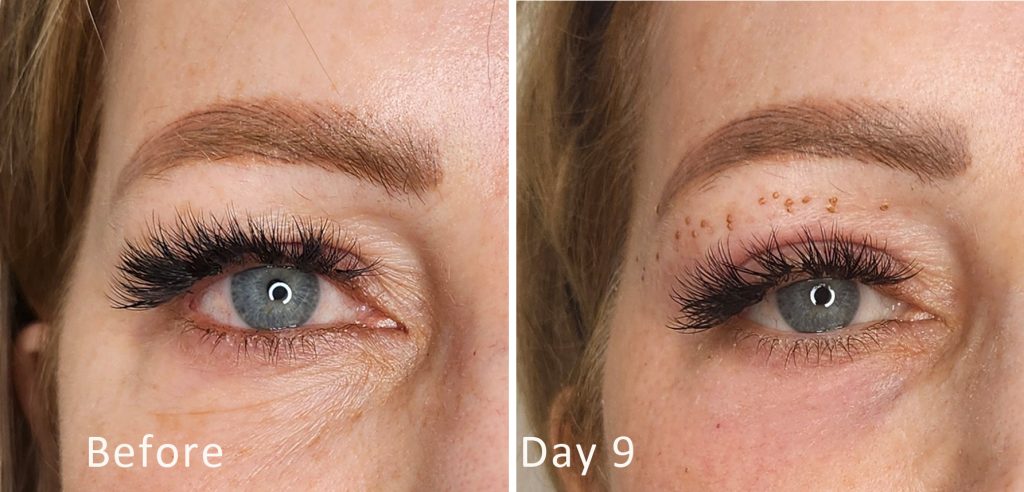
Plexr under eye before and after, Day 9, following one treatment to the upper and lower eyelids.
What the Before and After Photos Show
**All photos in this post are unretouched. The only changes are cropping, labels, and the red markings added to show the lift.**
Upper eyelids. Take a look at how much skin was sitting over her upper lids before treatment compared with Day 9. I estimate approximately 5 mm of visible lift, with considerably more of her upper eyelid now showing.
Her lash extensions obscure some of the change, so the red marks help show it. Before treatment, the lid was resting on the lash line. At Day 9, it has lifted clear.
That’s a meaningful change from one treatment.
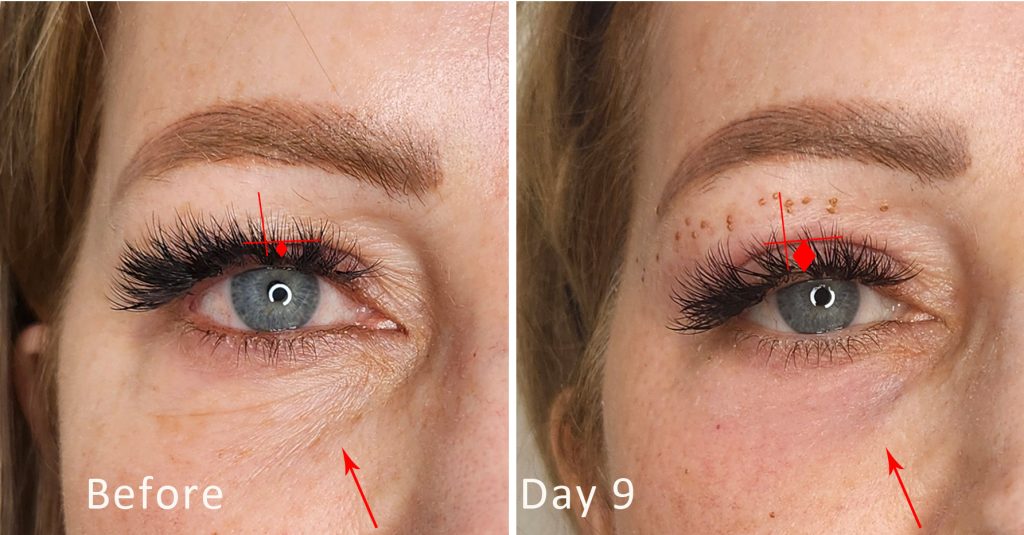
Before and Day 9, showing lift in the upper eyelids after one Plexr treatment. Red marks show where the lid has lifted off the lash line.
Under the eyes. This is where her before and after photos show an equally impressive change.
The loose skin visible beneath her eyes before treatment is no longer apparent in the Day 9 photos. Both lower eyelids look smoother and firmer.
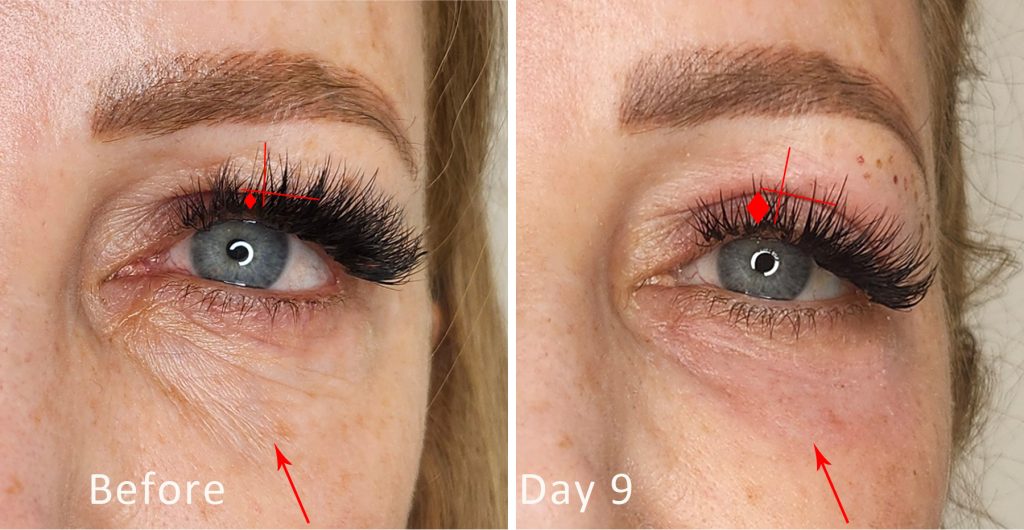
Before and Day 9, showing the change in lower eyelid laxity. Red arrows mark the under-eye area.
In practice, we generally see around 30% improvement in laxity per session.
Hers is a strong early result. That said, every person’s skin responds differently. Starting laxity, tissue quality, healing, and individual biology all play a role.
Video of Plexr upper and lower eyelid treatment before and 13 days after one semi-ablative session.
The Results Are Still Developing
Here’s something worth understanding about Plexr: the day the crusts come off isn’t the day the results are finished.
Most clients plan for 7–10 days of visible downtime after Plexr eyelid treatment. At Day 9, a few remaining crusts are consistent with the expected healing window.
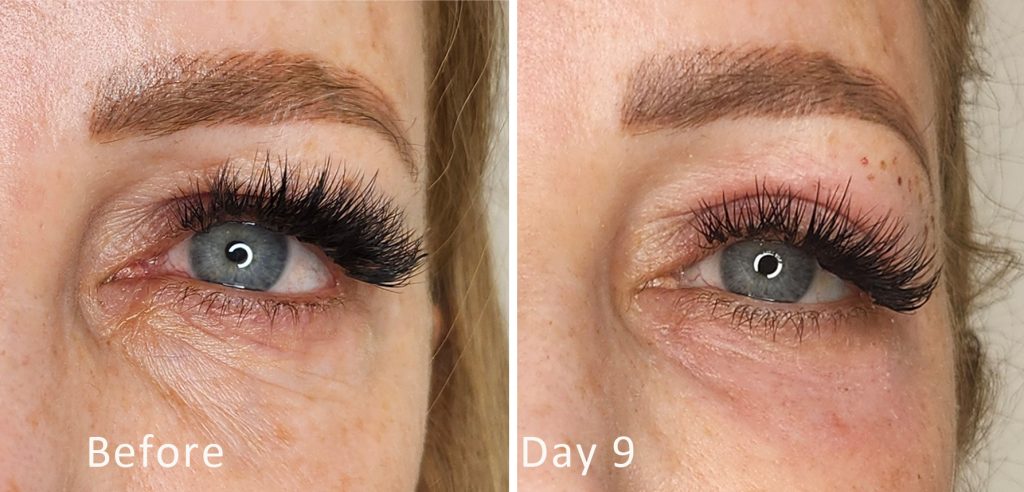
Day 9, with a few small carbon crusts still in place on the upper lid as the skin finishes healing.
Once they fall away naturally, the new skin underneath may remain pink for several weeks, sometimes longer.
And the tightening? That’s still developing.
Skin contraction and tissue remodelling continue over the following weeks and months. So while these photos give us an exciting early look, there’s more healing and change ahead.
We’ll take another set of photos in a couple of months. I’m looking forward to seeing how her eyelids continue to improve.
For another eyelid case, see Plexr Before and After: One Eyelid Treatment, 13 Days Later, or browse more in our Plexr results gallery.
I Prepare People for the Recovery, Not Just the Treatment
If there’s one thing I make a point of, it’s preparing my clients for what healing actually looks like before they’re sitting at home wondering what’s happening to their face
Plexr recovery isn’t like a laser treatment or anything else most people have tried. And let’s be fair, swollen eyelids and little carbon crusts aren’t exactly anyone’s favourite look. They’re temporary, they’re expected, and they’re part of the process. Knowing that ahead of time makes a world of difference.
So preparation starts well before treatment day. We go through the healing stages during consultation, look at real recovery photos, and plan treatment around your schedule so you have the time and space to heal without added stress.
Everyone responds a little differently in how much they swell and how they feel from one day to the next. The healing trajectory itself is very predictable. My day-by-day healing guide walks through the process with real photos, but here’s the general progression:
- Days 1–3: Swelling develops and typically peaks around Day 2 or 3. Carbon crusts are present.
- Days 3–7: Swelling begins to settle. The crusts remain in place while the skin underneath repairs.
- Days 7–10: Crusts gradually release on their own, revealing fresh, delicate skin that needs careful protection.
Midlife skin can be a little slower to repair because declining estrogen affects wound healing, so I factor that into recovery expectations.
Because recovery is predictable, it’s easy to plan for. That means blocking off the downtime, staying out of the sun, and accepting that your eyelids won’t be ready for brunch for at least a week. Most people choose to stay home, so the week itself can be pretty boring. The healing is boring too, in the best way. It follows the same steps in the same order, and that’s exactly what I want to see.
You're Not Left on Your Own Through Healing
I take the recovery side of treatment every bit as seriously as the treatment itself. My care doesn’t end when you walk out the door.
Even when everything is progressing normally, healing can feel unfamiliar, especially around the eyes, where swelling can look quite dramatic for a few days.
My clients know they can reach me during business hours if something doesn’t look or feel right. I’d much rather answer a question on Day 3 than have someone sitting at home worrying about whether something is normal.
Most of the time, the answer is “That’s normal,” and hearing that directly from the practitioner who treated you goes a long way. If something does need a closer look, we’ll address it. You’re not left to figure things out on your own. We also book a follow-up appointment to check your progress and healing.
What She Noticed
Now for one of my favourite parts of this process.
She’s very happy with the results, and her friends have been noticing too.
One friend, who had no idea she’d had anything done, told her she looked “refreshed.” We both agreed that was the perfect word for it! “Refreshed” gets used a lot in aesthetics, so it’s great to see and feel what that means!
And personally, I love that kind of result. A visible change without looking like someone else.
What Happens Next
For now, we let her skin continue healing and see where the result settles over the coming months.
A small touch-up is always something we can discuss once healing and remodelling have progressed, but it’s certainly not a decision we need to make at Day 9.
She’s already had a beautiful response to one treatment. Anything further would be about small refinements.
Why the Eye Area Shows Change So Clearly
The skin around our eyes is the thinnest on the face, with fewer oil glands and less underlying structural support.
Add the collagen changes that come with age, especially through perimenopause and menopause, and it’s no surprise that the eyes are often one of the first places we notice laxity.
It’s also an area where even relatively small changes in skin position and tightness can make a noticeable difference. That’s part of what makes treating the upper and lower eyelids so rewarding.
If hooding is your main concern, Plexr for hooded eyelids covers treatment and results in more depth. For more on changes under the eyes, and treatment options for them – see my loose under-eye skin blog.
My Personal Thoughts
Results like this never get old for me.
What I value just as much, is a client getting through the healing week feeling prepared and supported, and coming out the other side happy with where they are headed.
Trust is everything in this kind of work. Letting someone treat your face, then relying on them through a week of swelling and crusts, is a big ask. I’m always grateful to my clients for placing that trust in me.
Common Questions
How long does Plexr take to heal around the eyes?
Most clients plan for 7–10 days of visible downtime. Swelling often peaks around Day 2 or 3, and carbon crusts typically release within the 7–10 day window, although some areas may take a bit longer. Pinkness can remain for several weeks, and skin tightening continues as the tissue remodels. My Recovery Guide shows each stage with real photos.
Does Plexr hurt on the eyelids?
Topical numbing is applied before treatment to make the procedure more comfortable. Most clients tolerate it well, although individual sensitivity varies. Swelling, tenderness, and tightness are expected during early healing, but significant or increasing pain isn’t something to ignore.
This post will be updated with follow-up photos as her healing and tightening progress.
If you’re considering Plexr for upper eyelid hooding or loose skin beneath the eyes, you’re welcome to book a personalized consultation at Gia Sena in Calgary. We’ll look at your skin, discuss what’s realistic, and make sure the treatment and recovery are a good fit for you.
Sarah is a Registered Nurse and founder of Gia Sena, providing regenerative plasma energy aesthetics in Calgary. With over 23 years in nursing, her work focuses on supporting long-term skin vitality through regenerative treatments tailored to perimenopausal and menopausal skin.
Sources
- Ashcroft, G.S., Dodsworth, J., van Boxtel, E., et al. (1997). Estrogen accelerates cutaneous wound healing associated with an increase in TGF-β1 levels. Nature Medicine, 3(11), 1209–1215. DOI: 10.1038/nm1197-1209
- Hardman, M.J., Ashcroft, G.S. (2008). Estrogen, not intrinsic aging, is the major regulator of delayed human wound healing in the elderly. Genome Biology, 9(5), R80. DOI: 10.1186/gb-2008-9-5-r80